About Me
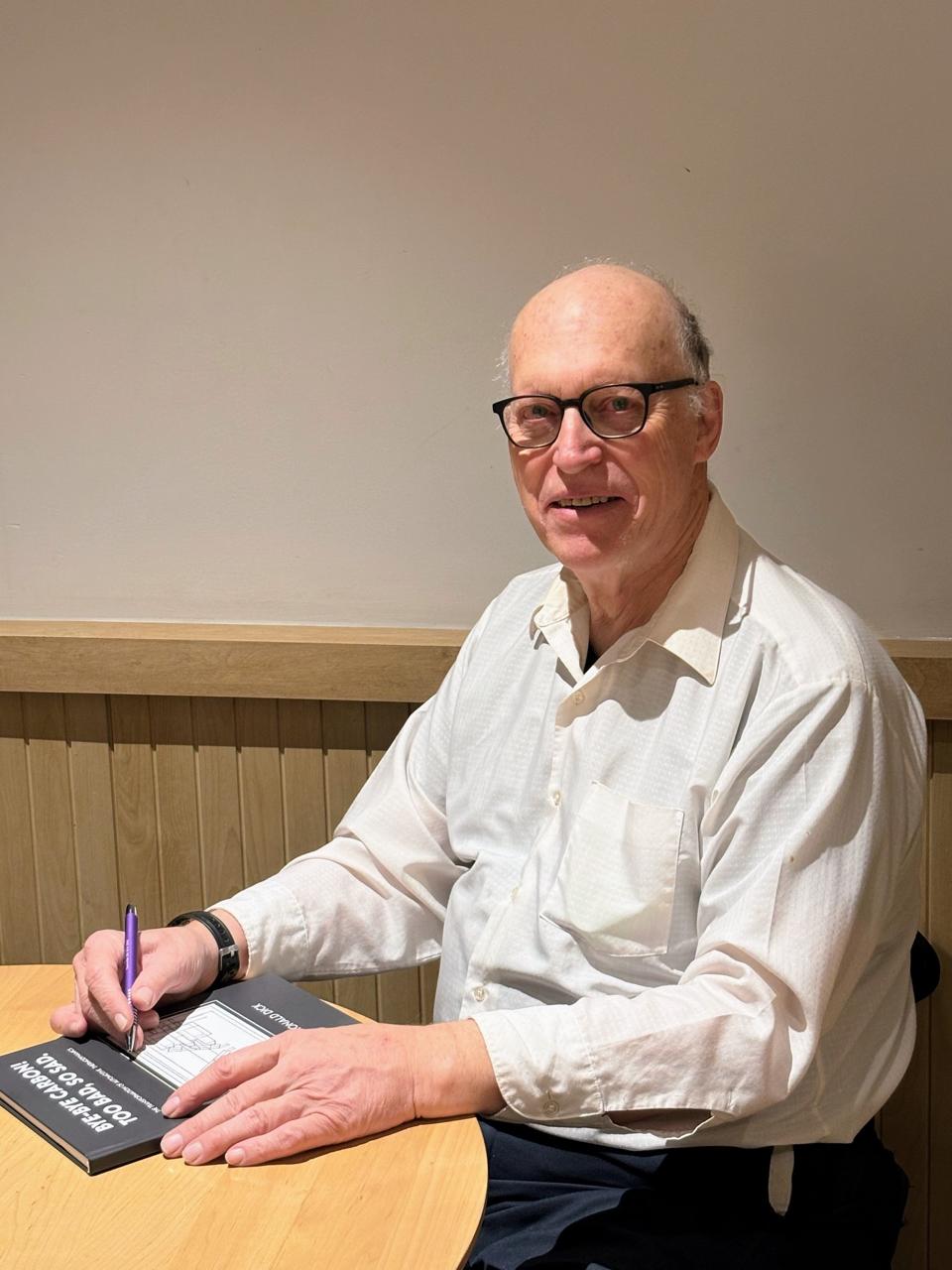
DAVID RONALD DICK
ABOUT DAVID RONALD DICK
David was born in 1953, in Dunnville Ontario, Canada, to parents David and Katie Dick, Mennonite vegetable farmers beside the Grand River. His youth was spent in a loving household with plenty of home cooked food and social activities with friends from the local Mennonite Church.
In 1959, David’s younger sister Loraine was born and they were the only children in the house. Summertime activities were wiener roasts with the fire on the gravel driveway, and skating on the river in the winter when the ice was safe. Singing hymns and children’s songs with others from church was one of the main forms of entertainment.
The children of the church put on a Christmas play every year. There was no television in the house until 1967 when David was 16 years old. His uncle bought the television because the Toronto Maple Leafs hockey team was in the Stanley Cup finals. They watched them win the Cup.
Modesty and productive hard work were the order of the day. Cars were black and made to last as long as possible. Clothes were black or gray in color. Women’s dresses for Sunday church were a modest blue color. Men’s work was mainly on the farm, while women worked in the house and on the farm.
David’s mother sewed dresses for funerals, weddings, and church using patterns and material on her Singer sewing machine. His sister Lorraine was top in her class and won the high school beauty pageant.
Children started to work on the farm as early as five years old. One day, David’s father took him to the greenhouses, where tomatoes and cucumbers were grown throughout the winter. His father needed to repair a leaking pump and asked David to hold the trouble light.
At first, David held the light so he could see the pump himself, not realizing that he was blocking his father’s view. His father then asked, “How could you hold that light differently, so that this repair can work better?”
This was a stunning revelation that taught David perspective outside of his personal existence. He adjusted the light so his father could see clearly, and the pump was repaired.
From that day onward, this question became his father’s guiding instruction: “How could you do it differently to make it work better?” David applied this principle throughout his youth and into adulthood, eventually using it for fifty-six years in pursuit of correcting automotive thermodynamics, culminating in Bye-Bye Carbon! Too Bad, So Sad.
In September, a bus came to pick David up for school. After thirteen years, he graduated from secondary school. Four years later, he earned a Bachelor’s degree in Systematic Theology from Canadian Mennonite University.
Five years later, he graduated with a First Class Stationary Engineer’s Diploma with the help of Niagara College (Welland) apprenticeship courses. Two key moments during this education sparked his lifelong and relentless automotive research.
The first moment of awakening occurred in a Grade Ten physics class. The lesson focused on the equation “Work equals Force times Distance,” written on the blackboard as “W = F × D.”
David, a country boy in a city school, was used as the example. The teacher referred to him as “Mr. Dick,” causing the class to giggle. The teacher described sending him to push against a tree for hours and then asked how much work had been done.
Despite many incorrect answers involving horsepower, BTUs, and kilowatts, David realized the tree had not moved. The distance was zero, making the work done zero. He answered correctly, and the equation became permanently embedded in his memory.
The second moment of awareness came during a First Class Stationary Engineering apprenticeship course focused on thermodynamics. Efficiency calculations revealed graphs of automotive fuel use.
Upon seeing these graphs, David immediately recognized a noncompliance with the basic physics equation he had learned years earlier. He realized that automobiles were using fuel inefficiently and incorrectly, driving him into a relentless pursuit to solve the problem.
Although he did not realize it at the time, David’s research moved in two directions: horizontal and vertical. Horizontal research involved studying existing transmissions and drivetrains, including gears, ratios, engine specifications, and methods of operation.
He filled numerous notebooks attempting to solve the fuel use problem through mechanical redesign, but despite persistent effort, no solution emerged.
This failure forced him into vertical research, focusing on physics and thermodynamics, particularly Newton’s Laws of Motion. Despite exhaustive theoretical efforts, success remained elusive.
Believing his limitation was a lack of contextual understanding, David wrote summaries of his integrated theology studies into thermodynamics manuals, hoping to broaden his perspective. After a month, he returned to scientific research.
One day, while studying Newton’s Laws, he realized that the Third Law left unanswered questions about equal and opposite reactions. In a moment of revelation, he identified what he called the Fourth Law of Motion.
This breakthrough enabled progress toward a compliant transmission design. Months of iterative development, guided by the Fourth Law, eventually produced a functional hydra-mechanical transmission capable of using fuel according to true energy requirements.
With the solution in place, David focused on publishing the book. Writing it deepened his understanding of physics and engineering and revealed the collective potential of engineers, scientists, policymakers, and environmental professionals to transform automotive transportation.
Auto engineers could design compliant transmissions, scientists could develop engines with 50% or greater efficiency, policymakers could support financing, and environmental professionals could anticipate massive reductions in carbon emissions.
Collectively, these efforts could make automotive transportation sustainable and responsible.